
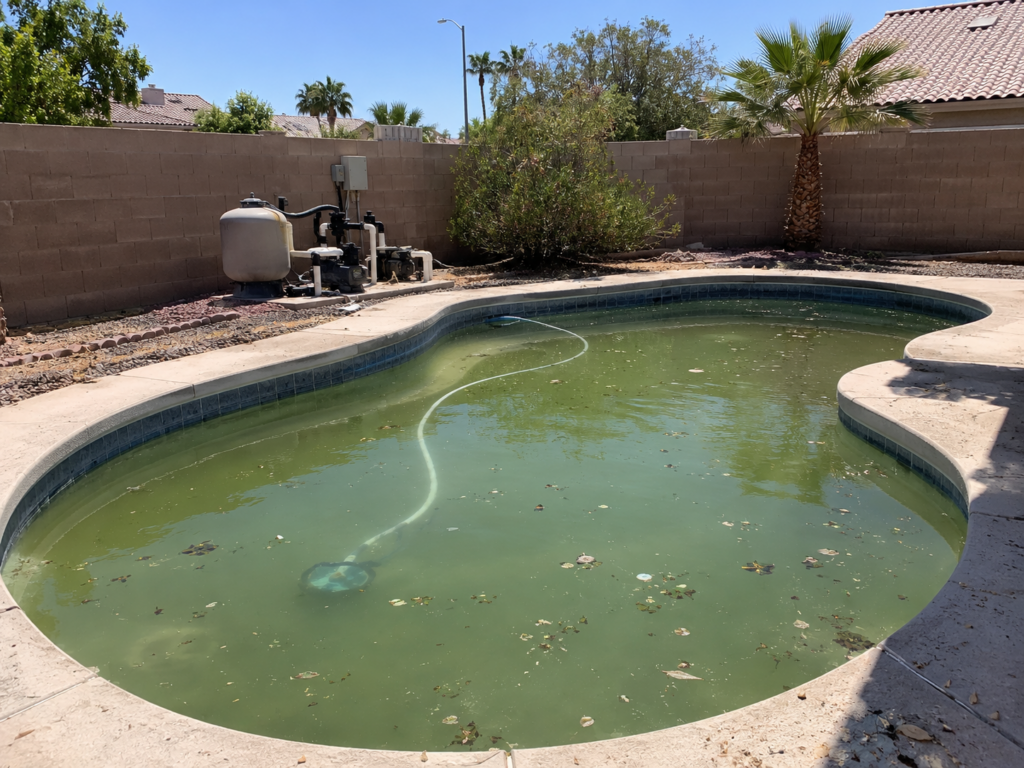
A pool that has gone green is one of those problems that feels like it disqualifies you.
It doesn’t.
Houses with neglected pools sell in Las Vegas all the time. What changes isn’t whether you can sell — it’s who is realistically going to buy, and how much of the fix the market expects you to handle first.
Why a Pool Gets Extra Attention Here
In a lot of the country a pool is a luxury feature. In the Las Vegas valley it’s close to standard, which means buyers here look at pools more critically than they do elsewhere. They’ve seen a few.
A pool that’s been sitting also tends to advertise itself. Cloudy or green water, a plaster surface that’s rough or stained, equipment that hasn’t run in a season — those read instantly as “this house has been empty a while,” and buyers extend that assumption to the rest of the property whether it’s fair or not.
That’s why pool condition often affects a sale out of proportion to what the repair itself would cost.
What Actually Slows the Sale Down
It’s rarely the water. It’s the paperwork the water triggers.
- Inspections. Pool equipment, surfaces and safety features usually get flagged, and an inspector’s language tends to be more alarming than the underlying problem.
- Financing. Some loan programs care about pool safety and condition, particularly where a barrier, fence or gate is missing or non-compliant.
- Appraisals. A pool in poor condition may be treated as contributing little value, or as a deduction.
- Insurance. Carriers ask about pools, and an unfenced or unmaintained one can complicate a buyer’s policy — which then complicates their loan.
- Buyer nerves. Most buyers have no idea whether a green pool is a weekend of chemicals or a full resurface, so they assume the expensive version.
Any one of these is workable. Stacked together, they’re why a financed buyer can take weeks longer on a house with a neglected pool than on the identical house without one.
Draining It Is Usually the Wrong Instinct
A lot of sellers’ first thought is to just empty the thing so it stops looking bad.
That can make the problem worse. An empty pool can shift or pop in certain soil and groundwater conditions, plaster can crack as it dries out, and an empty basin is its own safety and liability question. A dry pool also doesn’t read as “fixed” to a buyer — it reads as “broken and abandoned.”
If the pool is going to sit, keeping it circulating is generally the cheaper path. Worth a call to a pool professional before making that call either way.
Repair First, or Sell As-Is?
Fixing a pool before listing can pay off when the issue is cosmetic and the house is otherwise ready — clear the water, service the equipment, and you’ve removed the thing buyers fixate on.
It pays off less often when:
- the pool needs resurfacing or structural work, not a cleanup
- the equipment has failed and is out of date
- the house needs other repairs too, and the pool is one line on a longer list
- the property is vacant, inherited, or being sold under a timeline that doesn’t leave room for contractors
- you’d be borrowing or draining savings to fund work on a house you’re leaving
At that point you’re spending real money and weeks of calendar to make a house more appealing to a buyer who may still ask for a credit. That math stops working quickly. Should I fix my house before selling in Las Vegas is worth reading if you’re weighing that decision on more than just the pool.
When Selling As-Is Makes More Sense
Selling directly takes the pool out of the negotiation entirely.
At Fast Ready Offer, we’ve purchased 80+ homes in Clark County, and plenty of them came with pools in every condition — green, empty, cracked, or full of a decade of leaves. We buy as-is. No resurfacing, no equipment replacement, no draining it before closing, no repair credits negotiated at the last minute.
If you want to compare paths, you can request a no-obligation cash offer and set it next to what listing would look like after repairs, holding costs, and commissions. Sometimes fixing the pool first still wins. Sometimes it clearly doesn’t. Either way you’ll be deciding with a real number instead of a guess.
There’s no obligation, and no pressure to decide today.
Close on your terms.
FREQUENTLY ASKED QUESTIONS
Do I have to fix a green pool before selling?
No. You can sell a house as-is with a pool in any condition. Cleaning it up may widen your buyer pool, but it isn’t a requirement for a sale.
Does a pool in bad shape lower my home’s value?
It can reduce what an appraiser credits the pool with, and it often affects buyer confidence more than it affects the actual number. A well-maintained pool adds less value in Las Vegas than most owners expect, and a neglected one subtracts more.
Should I drain the pool if I’m not using it?
Usually not on your own. Draining can cause structural and plaster problems depending on conditions, and an empty pool raises its own safety questions. Ask a pool professional before draining.
Do I have to disclose pool problems to a buyer?
Nevada sellers are generally expected to disclose known material defects in the property, and pool issues can fall under that. Disclosing known problems is also simply the cleaner path — surprises during inspection are what kill deals.
Can a buyer get a loan on a house with a broken pool?
Sometimes. It depends on the loan program and on safety items like fencing and barriers. It’s one of the more common reasons a financed offer on a pool home takes longer or falls through.
What if the pool has a safety or fencing problem?
Fencing and barrier requirements are a real factor for both insurers and some lenders. If a barrier is missing or non-compliant, expect it to come up — and expect it to matter more to a financed buyer than to a cash buyer.
Do you buy houses with pools that need work?
Yes. Condition of the pool doesn’t change whether we’ll make an offer. We buy the property as it sits.